
Decommissioning vs. Office Relocation: What’s the Difference (and Which One You Actually Need)
You signed a lease three years ago and never read the restoration clause closely. Now the move-out date is approaching, your new space is being built out, and the landlord just mentioned “broom-clean condition” and “removal of all tenant improvements.” Suddenly you’re not sure whether you’re managing a move, a teardown, or both at once. That confusion is normal. Decommissioning and office relocation get used interchangeably, but they are two distinct projects with different goals, timelines, and risks. Treating one like the other is where companies lose money and miss deadlines.
The core difference in one sentence
Relocation is about getting your business set up somewhere new with as little downtime as possible. Decommissioning is about returning a space you’re leaving to the condition your lease requires. One is focused on the destination. The other is focused on what you leave behind. They can happen on the same week, in the same building, on the same project plan, but the success metrics for each have almost nothing in common.
What office relocation actually involves
An office relocation moves your operations, people, furniture, and technology from point A to point B. The whole exercise is measured by continuity. If your team can’t take calls, access files, or sit at a desk on Monday morning, the move failed, no matter how carefully the boxes were stacked. A relocation that’s planned well covers the parts most people forget until they’re standing in an empty hallway.
- Sequencing departments so revenue-critical teams move last and come online first
- Disconnecting, transporting, and reconnecting workstations, servers, and AV equipment
- Protecting and reinstalling modular furniture systems and conference setups
- Coordinating freight elevators, loading docks, and certificates of insurance at both buildings
- Inventorying assets so nothing disappears between the old floor and the new one
The hard part of relocation isn’t lifting. It’s the schedule. Move too fast and you break things. Move too slow and you pay rent on two spaces while productivity stalls. The right partner builds the timeline around your business hours, not the other way around.
What decommissioning actually involves
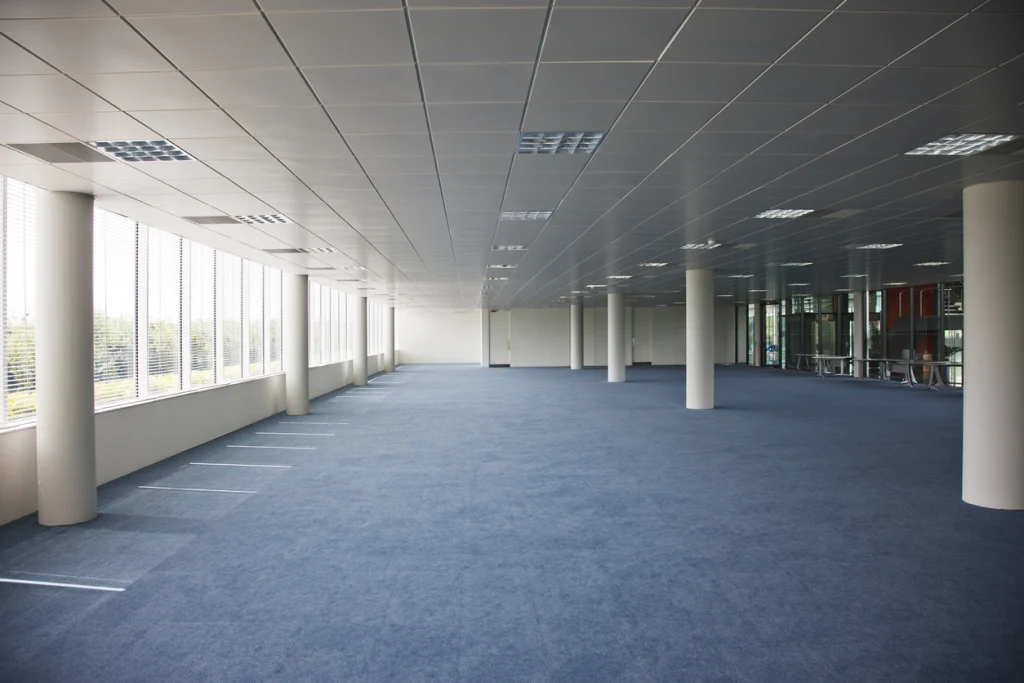
Decommissioning is the structured shutdown of a space you’re vacating. The goal isn’t to set anything up. It’s to hand the keys back without triggering penalties. Most commercial leases include a restoration or surrender clause requiring you to return the premises in a defined condition, often “as originally delivered.” That can mean removing cubicles, patching walls, taking out cabling you installed, uninstalling signage, and disposing of everything you’re not taking with you.
A real decommissioning project usually includes:
- Removing furniture, fixtures, and equipment (often called FF&E) down to bare floor and walls
- Pulling out abandoned data and electrical cabling per lease and code requirements
- Responsibly liquidating, donating, or recycling assets instead of dumpstering them
- Securely handling IT hardware and any drives that held sensitive data
- Documenting the cleared space with photos and certificates for your landlord and your records
Where relocation is judged by uptime, decommissioning is judged by your security deposit and your final invoice from the landlord. Skip a step and you can lose tens of thousands of dollars to restoration charges the building handles on your behalf, at their rates, on their schedule.
Why people confuse the two
The overlap is real. A typical office consolidation involves moving the team you’re keeping to a new floor, then emptying and restoring the old one. From the outside it looks like a single event. But the two halves run on opposite logic. The relocation half wants speed and continuity. The decommissioning half wants thoroughness and documentation. When one vendor handles the move and another handles the teardown with no shared plan, things fall through the cracks, usually expensive things like cabling, data destruction, and the surrender inspection.
A quick way to tell which project you have
Ask yourself one question: at the end of this, do I need a working space somewhere, or do I need an empty space behind me, or both?
- You’re moving and keeping the location’s purpose: that’s a relocation.
- You’re closing, downsizing, or going remote and leaving a space for good: that’s a decommissioning.
- You’re moving the operation and surrendering the old lease: that’s both, and they need to be planned together.
When they happen at the same time
Most of the trouble we see comes from projects that are genuinely both but get managed as one. The smart approach is to plan them as parallel tracks under a single point of accountability. Your operational equipment and the people who depend on it go to the new space first. Then the old space gets cleared, restored, and documented against the lease, so the surrender inspection is a formality instead of a negotiation.
Running both tracks together has real advantages. The same crew that knows your inventory can decide on the spot what moves, what gets liquidated, and what gets recycled, which means fewer touches and less double-handling. It also closes the security gaps that open up when furniture, electronics, and data-bearing hardware sit unattended in a half-empty building between vendors.
What to look for in a partner
Whether you need one service or both, a few things separate a clean project from a chaotic one:
- In-house, vetted crews rather than day labor, so the people handling your assets and data are accountable employees
- Secure warehousing for staging, short-term storage, or holding furniture between phases. Flood Brothers operates more than 500,000 square feet of secure space
- A documented chain of custody for IT equipment and anything that held sensitive information
- Liquidation and recycling channels so usable assets recover value instead of becoming disposal costs
- One plan and one project manager covering both the move and the surrender, with 24/7 availability for off-hours work
Flood Brothers has handled commercial relocations and decommissioning since 1997, and the reason both live under one roof is simple: most real-world moves are a little of each. Pretending they’re the same project is what gets companies in trouble. Planning them as one coordinated effort is what gets you out of an old lease on time and into a new space that’s ready to work.
Not sure which one your move calls for? Let us walk the space and map it out. Explore our decommissioning and liquidation services, or request a free project review and we’ll build a plan that covers both the move and the handover. Call (866) 528-9137 to talk it through.
Keep Reading

April 28, 2026
What Is Commercial Decommissioning, and When Do You Actually Need It?
Commercial decommissioning is how you hand a building back the right way. Here is when you need it, what it covers, and how to…
Read more →
July 6, 2023
Green Decommissioning: How to Close or Relocate a Facility Without Filling a Landfill
Closing or relocating a facility creates tons of waste fast. Here's how green decommissioning keeps assets out of the landfill and recovers real value.
Read more →Trusted by industry leaders
Enterprises that count on Flood Brothers
Your team demonstrated a level of urgency and attention to facility protection that I had not seen before.
We highly recommend Flood Brothers without reservation. They were on time, professional, and customer service-oriented.
We are very fortunate to have Flood Brothers as one of our partners, as they are willing to do whatever it takes to provide quality service.
Let's Plan Your Move
Get a Plan Built Around Your Business
Every project starts with a free review. We scope it in person and send back a plan with clear pricing.