
Green Decommissioning: How to Close or Relocate a Facility Without Filling a Landfill
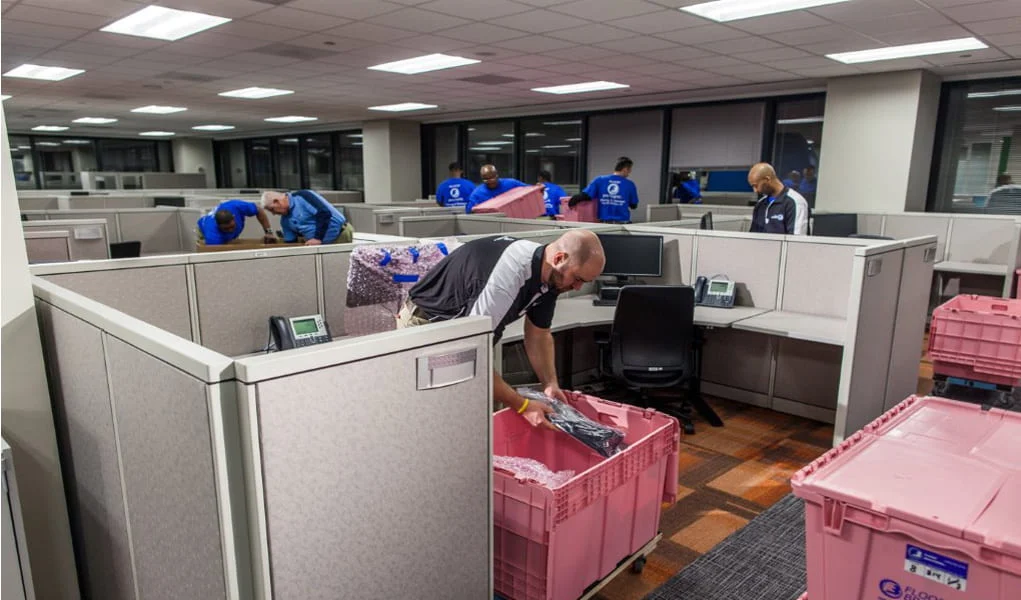
When a lease ends or a facility consolidates, the building has to be handed back empty, broom-clean, and often within a tight window. The fastest way to hit that deadline is also the worst one: rent a row of dumpsters and throw everything in. That approach buries usable furniture, working electronics, and recyclable materials in a landfill, racks up disposal fees, and can leave you out of step with your own sustainability commitments. Green decommissioning is the alternative. It clears the space on schedule while routing as much as possible toward reuse, resale, donation, and recycling instead of the dump.
What Green Decommissioning Actually Means
Decommissioning is the process of fully clearing a commercial space, dismantling workstations, removing equipment, disconnecting fixtures, and returning the building to its required condition. The “green” part is about where everything goes. Instead of treating every desk, server, and ceiling tile as trash, a sustainable approach sorts assets by their highest possible use and disposes of the rest responsibly.
It applies anywhere a business is changing its footprint: corporate offices, warehouses, manufacturing floors, medical and lab spaces, and retail locations. Whether you’re closing a site entirely or relocating to a new building, the same principle holds. The material leaving the old space is a problem to be managed thoughtfully, not a pile to be dumped.
Why the Waste Numbers Are Worse Than You Think
The scale of office waste is easy to underestimate until you’re standing in an emptied building. Industry estimates put roughly 17 billion pounds of office assets into U.S. landfills every year. A single office relocation can generate around 270 tons of waste and produce on the order of 1,500 metric tons of carbon when assets are scrapped and replaced rather than reused.
The flip side is just as striking. Keeping one desk in service instead of buying new can cut its associated carbon footprint by roughly a third. Multiply that across hundreds of workstations, chairs, monitors, and filing systems and the difference between “dumpster” and “diversion” becomes a measurable sustainability result you can report.
The Business Case Beyond the Environment
Doing this well isn’t only an environmental decision. It protects your budget, your reputation, and your compliance standing at the same time.
- Recovered value. Quality furniture, IT hardware, and equipment have resale and trade-in value. Donations can also generate tax benefits. Both offset the cost of the project.
- Lower disposal costs. Landfill tipping fees are charged by weight. Every ton you divert to recycling or reuse is a ton you don’t pay to bury.
- Regulatory protection. Electronics, batteries, ballasts, and certain fixtures fall under e-waste and hazardous-material rules that vary by state. Proper handling keeps you clear of fines.
- Data security. Decommissioned servers, copiers, and drives hold sensitive information. Certified destruction and chain-of-custody documentation close that gap.
- Reputation. Employees, clients, and communities increasingly expect responsible closures. A documented diversion rate is something you can stand behind.
How a Sustainable Decommission Comes Together
A clean, low-waste project doesn’t happen by accident. It follows a sequence, and the planning at the front end determines how much actually stays out of the landfill.
1. Inventory and Audit
Before anything moves, everything gets catalogued: furniture, IT assets, appliances, fixtures, and materials. The audit sorts each item by condition and best outcome, reuse at the new site, resale, donation, recycling, or disposal. This is where the diversion plan is born.
2. Sort by Highest Use
The goal is to push every item as far up the ladder as possible. Reuse beats resale, resale beats donation, donation beats recycling, and recycling beats the landfill. Working monitors go to a reseller; older units go to a certified e-waste processor. Solid desks go to a nonprofit; particleboard that’s failing gets broken down for material recovery.
3. Handle Regulated Material Correctly
Electronics, fluorescent lamps, batteries, and certain coolant- or chemical-bearing equipment can’t go in a general dumpster. These need documented, compliant disposal through the right channels, with certificates where required.
4. Protect Your Data
Anything that stored information, drives, networked copiers, point-of-sale systems, gets wiped or physically destroyed with documentation you can keep on file.
5. Clear, Clean, and Document
The space is returned to required condition, and you receive reporting that shows what was diverted, recycled, donated, and destroyed, the paper trail that turns a good intention into a provable result.
Why Remote Work Made This Bigger
The shift to hybrid and remote work changed the math for a lot of companies. Organizations are shedding square footage, consolidating multiple offices into one, or closing locations outright. Every one of those moves produces a wave of surplus furniture and equipment. At the same time, the network of resale platforms, liquidators, and donation partners that accept business-grade assets has grown, which means there are more places than ever to send material that still has life in it. The opportunity to decommission responsibly has never been larger, but only if the project is planned for it from day one.
Common Mistakes That Send Value to the Dump
- Starting too late. When the clearance is squeezed into the final week, dumpsters win because there’s no time to sort. Build decommissioning into the move timeline early.
- No inventory. Without a catalogue, nobody knows what’s worth recovering, so everything gets treated the same.
- Ignoring the paper trail. If you can’t document diversion and destruction, you can’t report your sustainability outcome or prove compliance.
- Using separate vendors for everything. Splitting moving, IT, disposal, and recycling across uncoordinated contractors creates gaps where items fall through to the trash.
Why Coordinating It Under One Roof Helps
The cleanest decommissions tend to be the ones where moving, storage, asset handling, and disposal all run through a single coordinated plan. At Flood Brothers, our in-house employee crews handle the physical work directly rather than subcontracting it out, and our 500,000-plus square feet of secure warehousing means assets you want to keep, redeploy, or stage for resale don’t have to be rushed or scrapped for lack of space. Because we operate 24/7, the clearance can happen on a schedule that fits your lease deadline instead of fighting it. One team, one inventory, one chain of custody, that’s how material stays accounted for from the old building to its final, responsible destination.
If you’re planning a closure, consolidation, or relocation and want to keep usable assets out of the landfill, our decommissioning and liquidation services can help you do it on time and on budget. request a free project review or call (866) 528-9137 to map out your project.
Keep Reading

April 28, 2026
What Is Commercial Decommissioning, and When Do You Actually Need It?
Commercial decommissioning is how you hand a building back the right way. Here is when you need it, what it covers, and how to…
Read more →
February 26, 2025
Decommissioning vs. Office Relocation: What’s the Difference (and Which One You Actually Need)
Decommissioning and office relocation sound similar but solve very different problems. Here's how to tell them apart, where they overlap, and which one your…
Read more →Trusted by industry leaders
Enterprises that count on Flood Brothers
Your team demonstrated a level of urgency and attention to facility protection that I had not seen before.
We highly recommend Flood Brothers without reservation. They were on time, professional, and customer service-oriented.
We are very fortunate to have Flood Brothers as one of our partners, as they are willing to do whatever it takes to provide quality service.
Let's Plan Your Move
Ready to Move Without the Downtime?
Tell us about your project and timeline. We will build a plan around your business and send clear pricing, usually within one business day.