December 4, 2024
Why Medical and Tech Equipment Needs Specialized Relocation
An MRI machine or a rack of production servers is not a desk. Here is why specialized relocation protects your…
Read Article
Healthcare & Laboratories
Hospitals, clinics, and labs relocated by crews your compliance office can credential, with infection-control practice that survives an ICRA review and vendor coordination so equipment comes back certified, not just plugged in.
 Crews Your Compliance Office Can Clear
 ICRA-Aware Containment and Paths
 Biomed and OEM Windows Coordinated
 Phased Around Live Departments
Trusted by industry leaders
Your team demonstrated a level of urgency and attention to facility protection that I had not seen before.
We highly recommend Flood Brothers without reservation. They were on time, professional, and customer service-oriented.
We are very fortunate to have Flood Brothers as one of our partners, as they are willing to do whatever it takes to provide quality service.
Get Started
Tell us the departments, the equipment, and your target dates. A project manager who knows the credentialing process follows up within one business day.
(866) 528-9137Most inquiries are reviewed within 1 business day.
Who This Page Is For
Healthcare relocation has a gatekeeper that other industries do not. Before anyone discusses trucks or timelines, someone in compliance, infection prevention or safety has to be satisfied that the people entering the building are appropriate to be there.
That is usually the facilities director, the lab manager or the practice administrator’s real problem. You are not just buying a move, you are vouching for a vendor inside a regulated environment where patients are present, where an infection-control lapse is a reportable event, and where a piece of diagnostic equipment that arrives uncertified cannot legally be used on a patient no matter how carefully it traveled.
So the work starts with those constraints. The crating, transport and reinstallation methodology lives on our medical equipment installation service page.
Sensitive Equipment, Handled Right
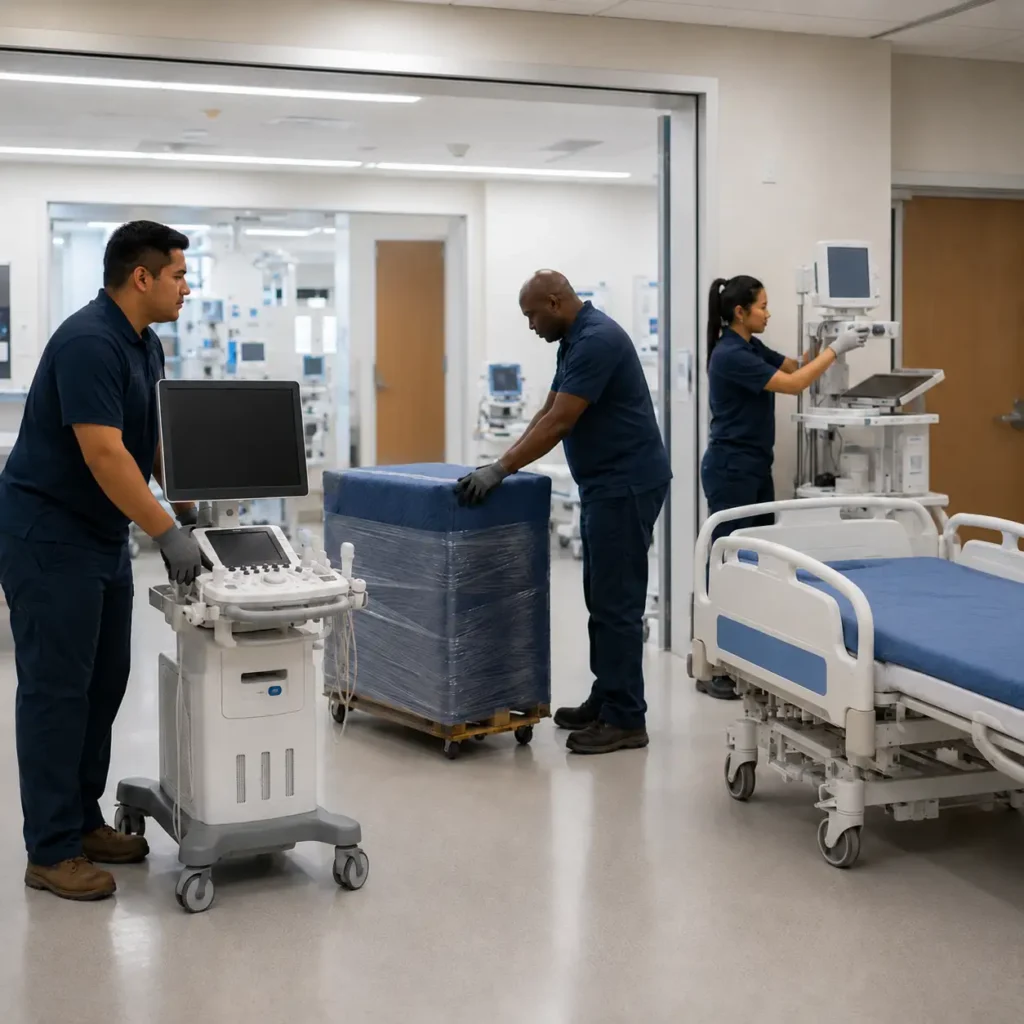
The equipment inside a healthcare facility is the most valuable, and most fragile, thing we will ever touch. MRI and CT components, ultrasound and C-arm units, lab analyzers, fume hoods, server racks, and exam systems each have their own shutdown, transport, and re-certification requirements, and getting one wrong can sideline a department for days.
We coordinate directly with your biomedical team and the OEM service reps to sequence professional de-install, calibration, and re-certification around our move windows. Devices are powered down to spec, custom-crated and braced, monitored in transit, and set, leveled, and reconnected so they are ready for vendor sign-off the moment they land. We move the connected data center and IT infrastructure on the same plan, so PACS, EMR, and network systems come back online with the equipment that depends on them.
How It Works
We walk both sites with your facilities and clinical leads, inventory equipment and records, confirm infection-control and access rules, and map a department-by-department phasing plan.
We line up vendor de-install, calibration, and re-certification windows so regulated equipment is powered down to spec and ready for sign-off on the far end.
We crate, transport, and reinstall on nights and weekends, equipment set and leveled, casework rebuilt, records moved under chain-of-custody.
We walk each department with you, support vendor re-cert and validation, clear any punch-list item, and stay reachable as care resumes.
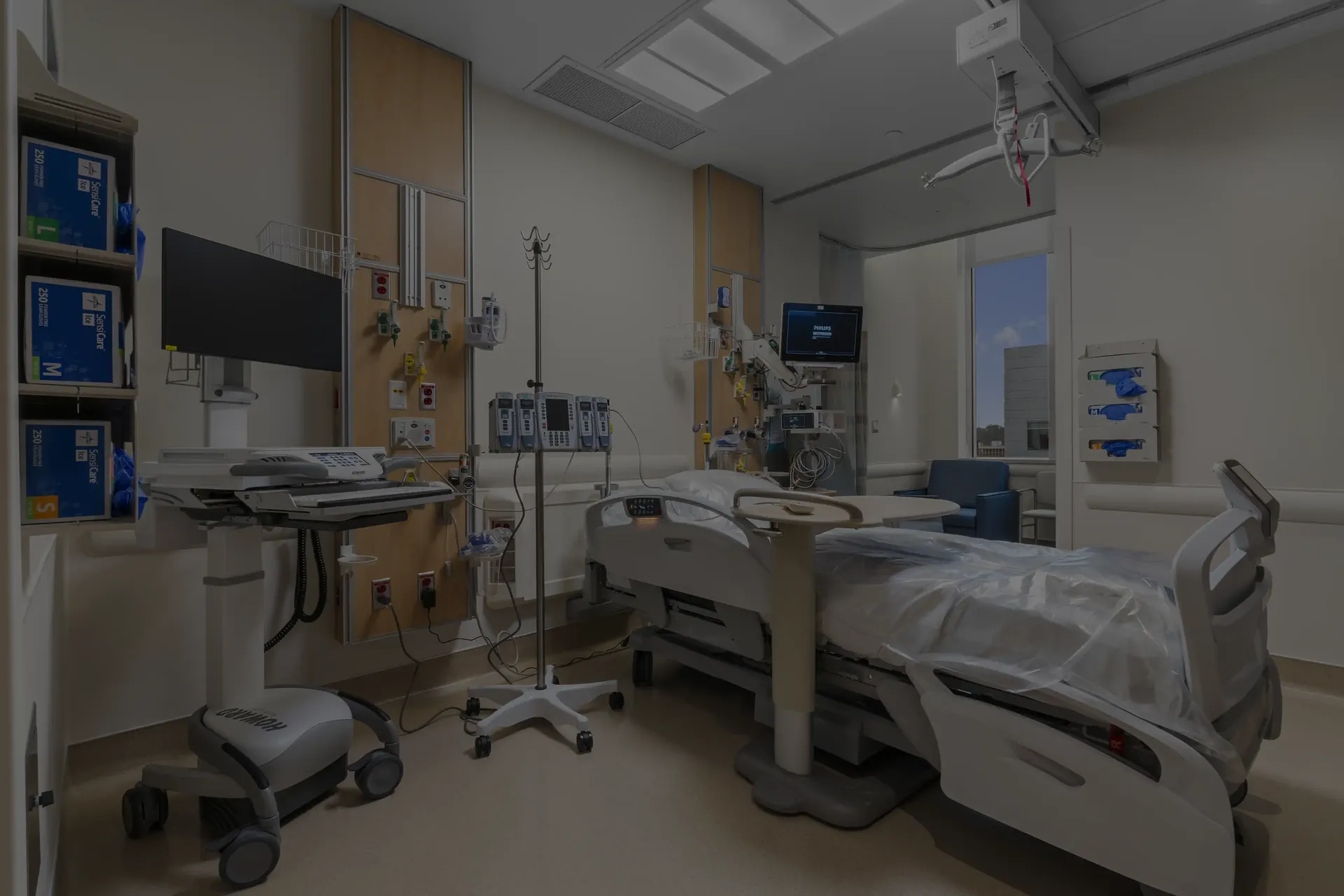
Credentialing and Infection Control
Expect a vendor credentialing process, and expect it to take longer than the move planning does.
Most health systems require background checks on every crew member who will be on site, current immunization records, and often a vendor credentialing platform registration before anyone is issued a badge. Some require annual training modules specific to the facility. Because our crews are full-time employees rather than day labor, we can put the same named people through that process and keep them on your project, which is difficult when the roster changes shift to shift.
Infection control is the other gate. Work in or near patient areas is typically governed by an infection control risk assessment, which dictates containment, negative pressure where required, protected transport paths, and how debris leaves the building. Clean and soiled routes stay separated. None of this is optional or negotiable on site, so it belongs in the plan rather than in a conversation with an infection preventionist on move night.
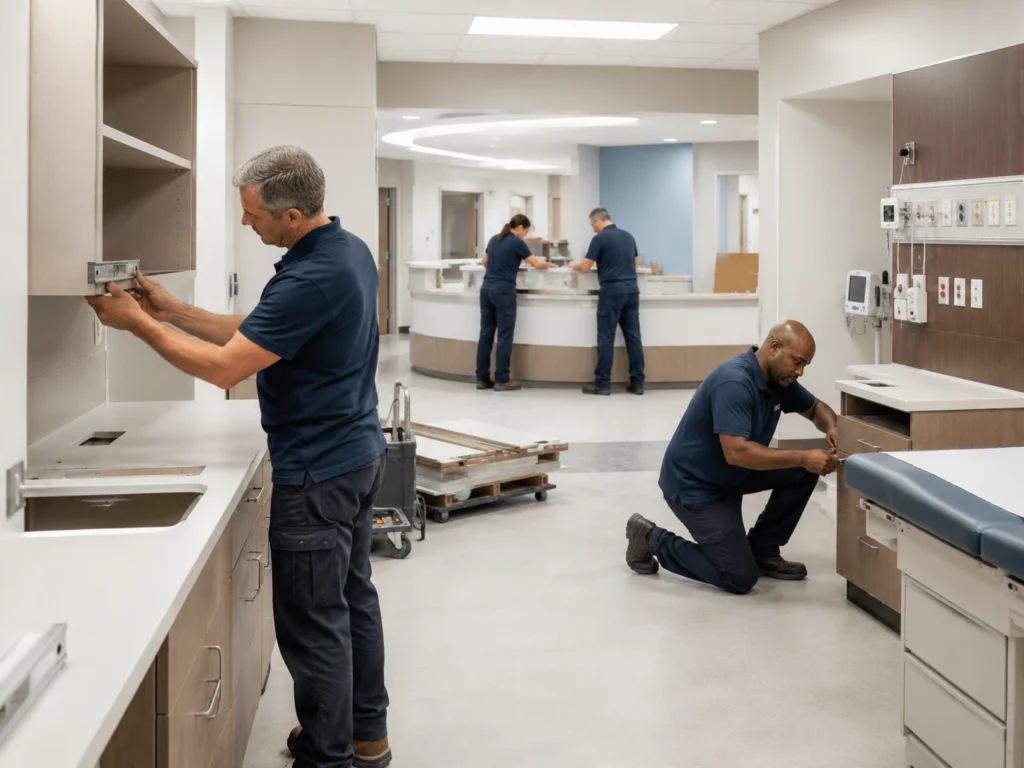
The Equipment Problem
The risk with clinical equipment is rarely damage in transit. It is a device sitting in the new room, physically perfect, that nobody is allowed to use yet.
Imaging and diagnostic equipment generally has to be de-installed and reinstalled by the manufacturer or an authorized service organization, then recalibrated and requalified before it returns to clinical use. Radiation-producing equipment often needs a physicist survey and state notification at the new location. Laboratory analysers need requalification and, depending on your accreditation, documented verification before patient testing resumes. Cold chain equipment carries its own validation and monitoring requirements.
Those vendor visits are scheduled appointments with lead times, not same-day calls. We build the move sequence around them, so equipment is set, levelled and ready exactly when the OEM or biomed window opens. Get that order wrong and you are paying for an idle room while you wait for a service engineer.
What's Included
Specialized handling for facilities where downtime reaches real patients.
Imaging, diagnostic, lab, and clinical equipment moved with custom crating and clean handling, sequenced with biomed and OEM for de-install and re-cert.
Nights, weekends, and off-peak windows, phased department by department so patient care continues without interruption.
Charts, films, and PHI move under a documented, HIPAA-aware chain-of-custody, secured and accounted for end to end.
In-house installers disassemble and rebuild exam rooms, nurse stations, labs, and modular casework exactly as they were.
Network, server, and clinical IT moved and brought back online with the equipment that depends on it.
Secure staging for phased openings plus white-glove logistics and delivery across single-site and multi-location moves.
The How Lives Next Door
Moving a healthcare facility combines several of our services. The operational specifics live on these pages.
Why Healthcare Teams Choose Us
Questions & Answers
Yes, and this is worth starting before you finalize a date. Our crews are full-time employees, so the same named people go through your background checks, immunization verification and credentialing platform registration and then stay on your project. Tell us which platform you use and what your lead time is, because credentialing is more often the schedule constraint than the move itself.
We work to your infection control risk assessment rather than to a generic policy. That means containment where the ICRA calls for it, protected and separated clean and soiled transport paths, debris removed on a defined route rather than through a patient corridor, and crews briefed on the specific requirements for that unit before they arrive.
We do not perform OEM de-installation or recertification, and you should be cautious of a mover who claims otherwise. Imaging and diagnostic equipment is generally de-installed and reinstalled by the manufacturer or an authorized service organization, then recalibrated before clinical use. What we do is handle the physical relocation and schedule our work tightly around those vendor windows so nothing sits idle.
Phased, department by department, with the heavy work in whatever off-peak window that unit can actually give up. A hospital never has a quiet moment, only quieter ones, and they differ by department. We plan from your census and schedule rather than assuming nights are automatically the answer.
Records move under a documented chain of custody, sealed and tracked, with access limited to credentialed crew and a receipt at each handoff. If your privacy office wants a business associate agreement in place before we handle PHI, raise it early so it is signed well before move week rather than the night before.
Guides & Insights
December 4, 2024
An MRI machine or a rack of production servers is not a desk. Here is why specialized relocation protects your…
Read ArticleMay 5, 2026
A practical guide to protecting treadmills, imaging machines, and calibrated medical gear during a commercial relocation without costly downtime.
Read ArticlePlan the Phasing
Send us the departments in scope, your equipment list and your credentialing requirements. We will walk both sites, coordinate with biomed and your vendors, and come back with a phased plan, usually within one business day.