
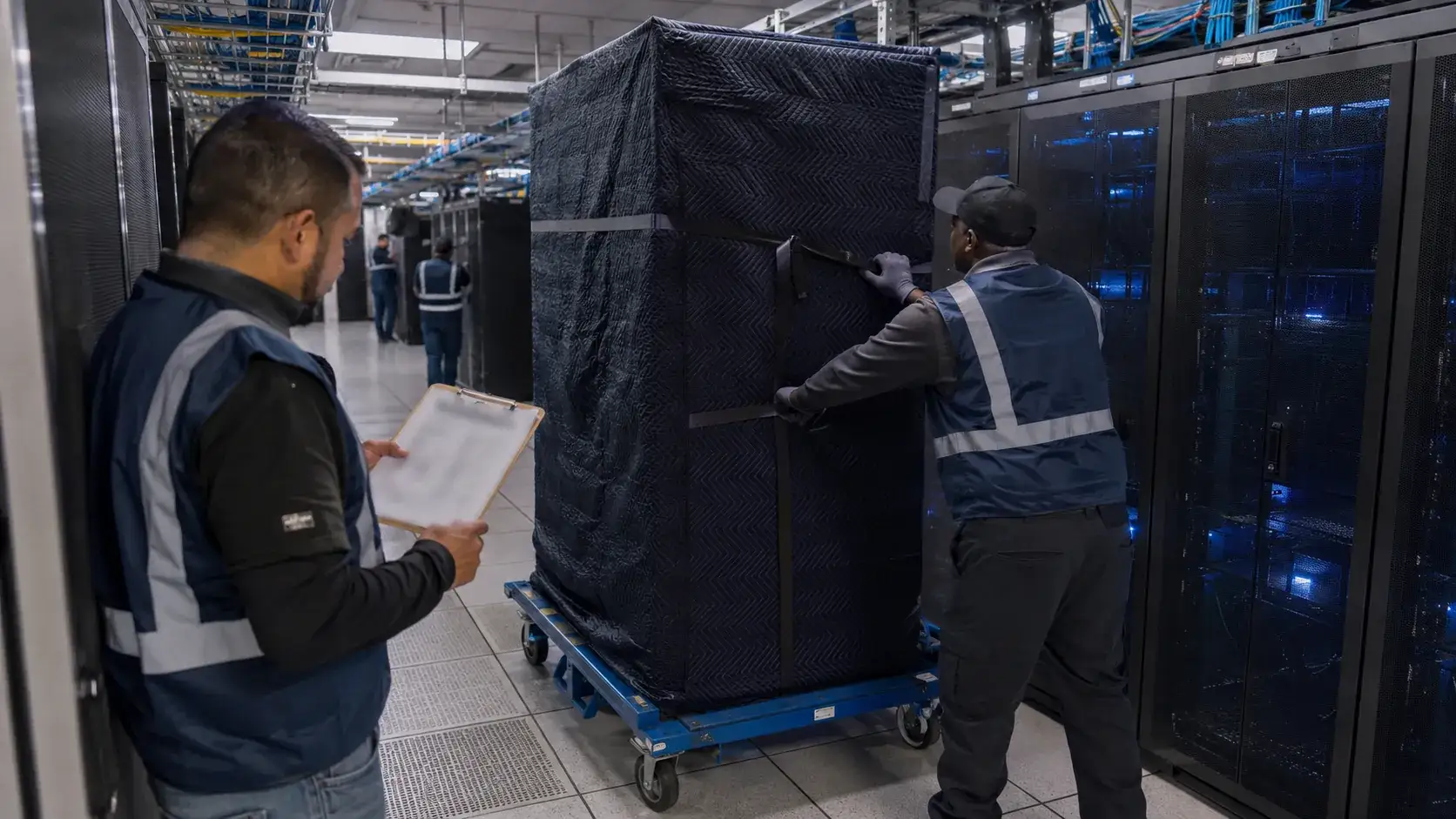
Data Centers, Labs & IT Infrastructure
Data Center Relocation for the People Who Answer for Uptime
You file the change request, tell customers what window to expect, and write the postmortem if it slips. Here is what that job needs from a moving partner: custody records your auditors will accept, crews your colocation facility will badge in without a fight, and a cutover that finishes before Monday starts.
-
 Custody Records Auditors Accept
-
 Background-Checked, Badged Crews
-
 Windows That Close On Time
-
 One Lead Who Owns the Plan
- Written for the director who owns the maintenance window
- Asset-level custody evidence for SOC 2 and ISO reviews
- Colocation access handled, from badge lists to escorts
- Rollback agreed in writing before the first rack rolls


Who This Page Is For
If the Outage Lands on Your Desk, You Are in the Right Place
Most people who call us about infrastructure are not shopping for a moving company. They are trying to close out a risk item. Someone upstairs approved a facility change, and now the director of infrastructure, the data center manager, or the MSP owner has to make it happen without burning an SLA credit or failing an audit along the way.
That job has a particular shape. You have a change advisory board that wants a rollback plan before it will approve anything. You have customers who need notice in writing, and a support queue that will tell you within minutes if the sequence was wrong. You have a security team that will ask who touched which drive and when, and will not accept “the movers had it” as an answer. And you have a window, usually a Saturday night, that does not stretch.
So this page answers the questions that come up in that conversation. It is not the process document. If you already know we are a fit and you want the methodology, the power-down sequencing, the de-rack and re-rack detail and the validation steps all live on our data center relocation service page.
Trusted by industry leaders
Enterprises that count on Flood Brothers
Your team demonstrated a level of urgency and attention to facility protection that I had not seen before.
We highly recommend Flood Brothers without reservation. They were on time, professional, and customer service-oriented.
We are very fortunate to have Flood Brothers as one of our partners, as they are willing to do whatever it takes to provide quality service.
Get Started
Ready to Scope Your Infrastructure Move?
Tell us about your environment, your sites and your window. We will follow up with next steps, usually within one business day.
(866) 528-9137
Thank you
Request Received
Most inquiries are reviewed within 1 business day.
Response in 1 business day or less

Access and Compliance
What Your Facility Will Demand Before Anyone Touches a Rack
The part that surprises people is rarely the lifting. It is getting a crew legally and physically into two buildings on the same night.
Colocation operators generally want a named access list submitted days ahead, government ID matched at the mantrap, and an escort assigned for anything outside your own cage. Many require background checks on every person on that list, and some re-run them annually. Your certificate of insurance usually has to name the facility operator as an additional insured, at limits the operator sets rather than limits you pick. Freight elevators and loading docks are reserved in blocks, and if you miss your block you wait for the next one.
Then there is the evidence side. If you carry SOC 2 Type II, your auditors will sample this move. If you touch protected health information or cardholder data, the custody trail is not optional, and it has to survive being read a year later by someone who was not there. We plan for that up front, because documentation cannot be retrofitted after the fact and still be true.
Why Tech Teams Choose Us
Infrastructure Moving Built Around Uptime
- 220+ Full-Time In-House Crew Trained experts for every part of your project.
- 500K+ Sq Ft of Warehousing Secure staging for phased colo and DC moves.
- 24/7 After-Hours Cutovers Maintenance windows that protect production.
- 100% In-House Equipment Crews The crew that de-racks is the crew that re-racks.
Who Calls Us
The Teams We Do This Work For
Different stacks, different auditors, same requirement: prove where every asset was, and give the window back on time.
-
Colocation and Hosting Operators
You are moving a customer between cages and their SLA does not pause for your facility change. We sequence around tenant windows and document per customer.
-
Managed Service Providers
Multi-client hardware in one truck is a custody problem before it is a logistics problem. Every device stays tracked to its client and its destination rack.
-
Enterprise IT and Infrastructure Teams
The server room moves as part of a larger office project, and you still own the uptime number. One project lead covers both halves.
-
SaaS and Platform Engineering
Staging, build and production hardware that other teams are blocked on. We move it in the order your dependencies actually run.
-
Telecom and Network Operators
Switching, routing and structured cabling relocated with labeling and documentation that survives the next audit.
-
Teams Retiring a Footprint
Not everything is moving. We de-rack, palletize and hand off to your ITAD processor with the same paper trail and certificates.
Where These Projects Break
Three Ways an Infrastructure Move Actually Fails
The window slips. Almost never because the trucks were slow. It slips because core network came back after storage, or a rack arrived without the rails it needed, and forty minutes of improvising became three hours. Sequencing is planning work, and it happens weeks before the night itself.
The paperwork does not survive. Assets get tracked on a whiteboard, the whiteboard gets wiped, and eleven months later an auditor asks for the custody trail on one specific array. If custody is not captured at each handoff as it happens, it cannot be honestly reconstructed later.
The crew cannot get in. A name was missing from the access list, the insurance certificate named the wrong entity, or the dock was already booked. The gear is fine, the plan is fine, and the night is gone anyway.
None of these are exotic. They are the normal failure modes, which is why we spend more time on access and sequencing than on the move itself.

Before You Commit
What We Can Put in Front of You
Ask any vendor for these early. If they cannot produce them, that tells you something useful.
A redacted chain-of-custody export from a real project. A certificate of insurance at the limits your facility requires, with the operator named as additional insured. Confirmation that everyone on your access list is a full-time Flood Brothers employee rather than day labor, which matters because your facility will run background checks against exactly that list. A written cutover sequence with the rollback point marked on it. And a project lead’s direct number, not a dispatch line.
We have run commercial relocation since the 1990s and hold 500,000 square feet of secure warehousing. That last number matters more than it sounds. Phased migrations stall constantly because a destination is not ready, and having somewhere secure and inventoried to stage racks is often the thing that keeps a schedule alive.
The How Lives Next Door
You Want the Methodology, Not Another Overview
Fit comes first. Once you are past that, the operational detail lives on the service pages, and those are the ones to forward to your engineers.
- Data center relocation covers power-down sequencing, de-rack and re-rack, structured cabling and validation.
- Office relocation is where the server room is one piece of a larger corporate move.
- Office decommissioning covers the space you are handing back, including gear you are not keeping.
- Secure storage and warehousing is the staging option when a phased migration needs somewhere to wait.
Questions & Answers
Data Center Relocation: Straight Answers to Common Questions
General
-
Our crews are full-time Flood Brothers employees, not subcontracted labor. That matters more operationally than it sounds. Your colocation facility will run background checks against the names on the access list, and a subcontracted roster that changes shift to shift makes that painful. The crew that de-racks at the origin is the crew that re-racks at the destination.
-
Four things, ideally three weeks out: an elevation or rack map for both sites, your maintenance window and the hard stop on it, the access requirements at both facilities including who is allowed to submit the crew list, and the name of whoever can approve a rollback decision at two in the morning. Everything else we can build from a site walk.
-
Every asset is tagged and scanned at each handoff, so each device carries a timestamped record of who had it and where it was. You get that as an export you can hand an auditor. We capture it as the work happens rather than reconciling afterward, because a custody record assembled after the fact is not evidence.
-
Yes, and it is a large share of what we do. We work to the operator’s access rules rather than asking for exceptions: named crew lists submitted ahead, ID matched on arrival, escorts where the operator requires them, dock and freight elevator time reserved in advance. Tell us which operator and we will usually already know their process.
-
We stage it. With 500,000 square feet of secure warehousing we can receive and hold racks and equipment, fully inventoried, until the destination is ready, then deliver in phases. Plan this as a branch of the schedule rather than an emergency, because a destination running late is the single most common disruption on phased migrations.
Plan the Window
Tell Us Your Window and We Will Tell You If It Is Realistic
Send us your sites, your maintenance window and your access requirements. We will walk the space, build the sequence backward from your go-live, and come back with a written plan and clear pricing, usually within one business day.