
Restaurants & Commercial Kitchens
Restaurant Relocation Built Around Your Opening Date
For the operator, franchisee or director of construction who has payroll starting, a lease clock running and an inspection that has to pass the first time. Here is what that job needs from a relocation and install partner: a schedule built backward from your open, and honesty about which connections we can and cannot legally make.
-
 Schedule Built Backward From Open
-
 Riggers for the Heavy Line
-
 Straight Answers on Licensed Work
-
 One Crew, Back of House to Front
- Written for whoever signed the lease and the payroll
- Rigging for ranges, hoods, walk-ins and dish machines
- Clear on what needs a licensed trade and what does not
- Sequenced around inspection, not around the truck

Who This Page Is For
If the Lease Clock Is Already Running, You Are in the Right Place
Restaurant projects run on a different clock than office moves. You are usually paying rent on a space that earns nothing, you have staff hired against an opening date, and every week of slip is a real number you can calculate.
Meanwhile the schedule depends on people who do not report to you. The GC has other jobs. The equipment dealer’s lead times move. The health department inspects when the health department inspects, and the hood suppression certification has to happen before that. Most operators we talk to are not looking for a mover, they are looking for someone who will hold a date and tell them the truth when it is at risk.
So this page covers fit and constraints. The rigging, setting and install methodology lives on our commercial kitchen installation service page.
Trusted by industry leaders
Enterprises that count on Flood Brothers
Your team demonstrated a level of urgency and attention to facility protection that I had not seen before.
We highly recommend Flood Brothers without reservation. They were on time, professional, and customer service-oriented.
We are very fortunate to have Flood Brothers as one of our partners, as they are willing to do whatever it takes to provide quality service.
Get Started
Ready to Move Your Restaurant?
Tell us about your project and we'll follow up with next steps, usually within one business day.
(866) 528-9137
Thank you
Request Received
Most inquiries are reviewed within 1 business day.
Response in 1 business day or less

The Challenge
A Commissary Line Doesn't Move Like Office Furniture
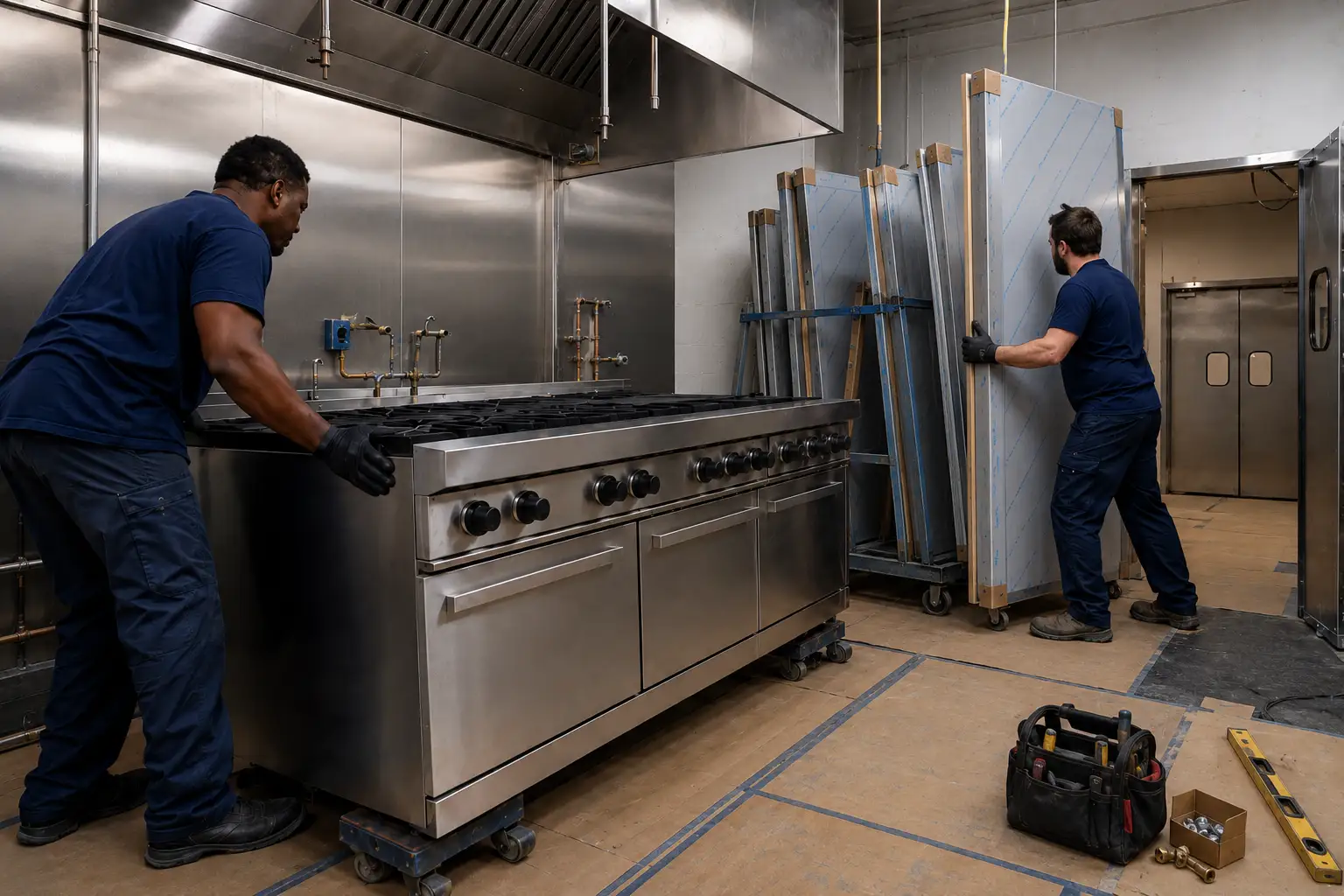
A working kitchen is a tightly packed grid of heavy, plumbed, and wired equipment, ranges and char-broilers, exhaust hoods, fryers, combi ovens, dish machines, and walk-in coolers and freezers, most of it crammed into back-of-house corridors and serviced through doorways it barely fit through in the first place. None of it is meant to be slid across a floor, and any piece dropped or racked out of square becomes an expensive, schedule-killing repair.
On top of the rigging problem sits a hard date. Refrigeration has to seal and hold the moment it is powered up, the line has to be level and ready to commission, hoods and fire suppression have to pass inspection, and the dining room has to be guest-ready the same day. Miss any of it and the opening slips while the rent keeps running.
How It Works
A Sequence Engineered Backward From Your Open
-
Site Walk & Equipment Inventory
We walk both spaces with your GC and kitchen designer, inventory every piece of equipment and FF&E, confirm access, door widths, and elevator limits, and send clear, fixed pricing.
-
Reverse Schedule & Trade Coordination
We set the install order working back from your opening date and inspection, then lock dates with your plumbing, gas, electrical, and refrigeration trades so no step waits on another.
-
Rig, Set & Level the Line
Our riggers move the heaviest equipment through tight kitchens, set each piece on spec, and level it so your trades can make final connections without re-shimming or re-fitting.
-
FF&E, Punch & Inspection-Ready
The same crew installs the dining room and bar, hauls the debris and packaging, and walks the punch list with you so the space is clean and ready when the inspector arrives.
The Line We Will Not Cross
What We Set, and What a Licensed Trade Has to Connect
This is the question worth asking every vendor early, because the wrong answer costs you an inspection.
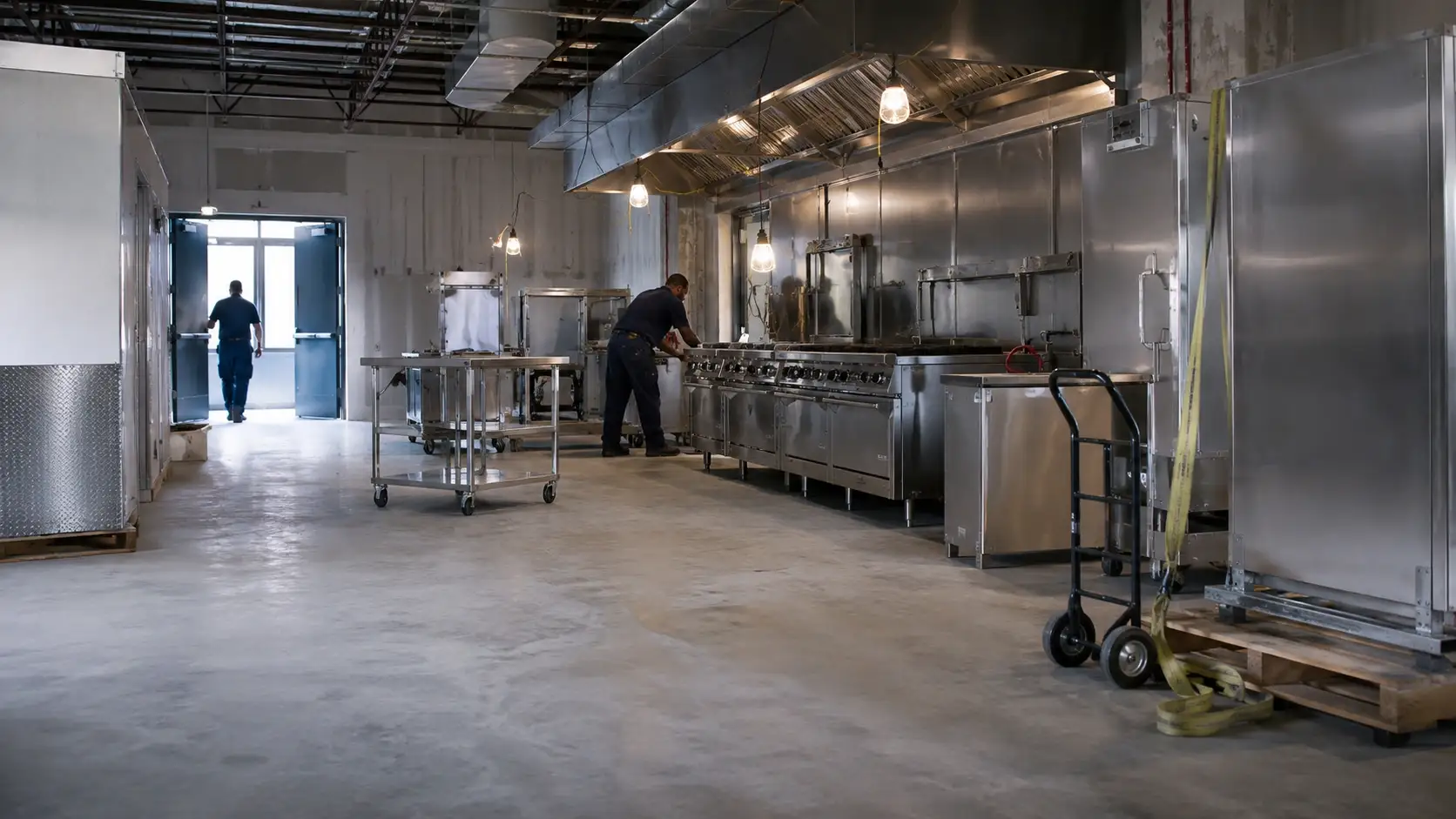
We move, rig, set and level your equipment, and we place it exactly to the kitchen design so the trades that follow are not solving our problems. What we do not do is make final gas, electrical, plumbing or fire suppression connections. Those require licensed trades, they are inspected as licensed work, and a moving crew that offers to “just hook it up” is offering you a failed inspection and an insurance problem.
The same applies to your hood and Ansul system. The suppression system has to be certified after the hood is set, and that certification is a scheduled visit from a licensed company, not a box anyone checks on move day. We plan the sequence so those trades arrive when the equipment is actually ready for them, which is most of what protects an opening date.
What's Included
Your Whole Restaurant, Moved and Installed by One Team
Back-of-house equipment to front-of-house FF&E, under a single accountable plan.
-
Commercial Kitchen Equipment
We disconnect, move, set, and reinstall ranges, char-broilers, fryers, combi and convection ovens, exhaust hoods, and prep stations, placed and leveled to spec so the line is ready to commission on schedule.
-
Refrigeration & Walk-In Coolers
Reach-ins, refrigerated prep tables, ice machines, walk-in coolers, and freezers are handled to protect compressors, condensers, panels, and door seals so they hold and seal the moment they are powered back up.
-
Heavy & Specialty Equipment Rigging
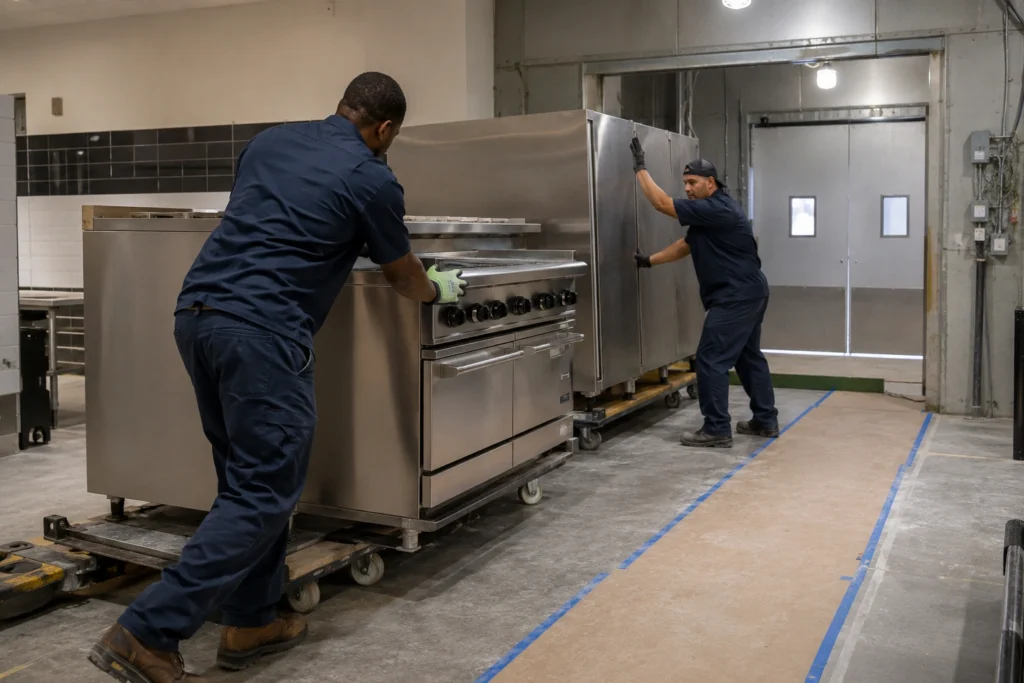
Some pieces are simply too heavy or awkward for a standard moving crew. Our riggers move oversized equipment through tight kitchens, down stairs, and around finished surfaces with the right gear, nothing dropped or dragged.
-
Dining Room & Bar FF&E
In-house installers set and level tables, booths, banquettes, chairs, host stands, millwork, and bar fixtures so the front of house is guest-ready on schedule under one plan.
-
Receiving, Warehousing & Staging
When new equipment and FF&E arrive before your space is ready, we receive and inspect them into more than 500,000 square feet of secure warehouse space, then ship to site in the order your crews install.
-
Removal, Decommission & Disposal
We pull the equipment and fixtures your new space is replacing, haul packaging and demolition debris, and store, resell, liquidate, or responsibly dispose of what you are leaving behind.
Where Openings Actually Slip
Three Things That Push a Restaurant Opening
Equipment lands before the space can take it. A walk-in delivered to a room without a finished floor gets moved twice, and the second move is the one that damages a panel. Receiving and staging equipment until the space is genuinely ready is boring and it saves weeks.
The heavy piece does not fit the path. A combi oven or a 30-barrel walk-in has one route into the building, and someone has to measure it against every doorway, turn and threshold before the truck is booked. When that measurement happens on delivery day, the piece goes back on the truck.
The trades arrive out of order. Suppression cannot certify before the hood is set. The inspector will not pass a kitchen where the trades are still working. Sequencing is the whole job, and it is planning work that happens weeks before anyone lifts anything.
The How Lives Next Door
You Want the Install Detail, Not Another Overview
Fit comes first. The operational specifics live on the service pages, and those are the ones to forward to your GC.
- Commercial kitchen installation covers rigging, setting, leveling and the dining room FF&E install.
- Industrial rigging is for the pieces too heavy or awkward for a standard crew.
- Receiving and secure storage is where equipment waits when the build-out runs long, which it usually does.
- Decommissioning and disposal covers stripping the space you are leaving or replacing.
Why Operators Trust Us With the Move
Relocation Experience That Protects Your Opening Date
- 100% In-House Crews Handled by our own in-house crews.
- 500K+ Sq Ft of Warehousing Receiving and staging for phased openings.
- 24/7 After-Hours Crews Overnight work to protect your service days.
- 95% of the U.S. Within Crew Reach Single-site moves to multi-location rollouts.
Questions & Answers
Restaurant Relocation: Straight Answers to Common Questions
General
-
No, and be wary of anyone who says yes. We move, rig, set and level the equipment to the kitchen design. Final gas, electrical, plumbing and fire suppression connections are licensed work, inspected as licensed work. We coordinate closely with your trades so they arrive when equipment is ready, which is the part that actually protects your date.
-
We build the schedule backward from your open and inspection, not forward from the move. We will also tell you in week one if the date is not realistic given equipment lead times and the trade sequence. A date nobody believes is worse than an uncomfortable early conversation, and most slipped openings were visible weeks before anyone admitted it.
-
For a relocation from a live location, yes, we work after last call and overnight so you lose as few service days as possible. Be realistic though: if the heavy line is moving, there is a period where you cannot cook. We would rather scope that honestly and compress it than promise zero downtime and hand you a surprise.
-
We receive and hold your equipment and FF&E in secure warehousing until the space is ready, then deliver it in the order the install needs. Build-outs run long often enough that we treat this as the default plan rather than the contingency.
-
Yes. Ranges, fryers, combi ovens, dish machines, walk-in panels and hoods are rigging work, and our riggers are in-house rather than subcontracted. The constraint is almost never weight, it is the path into the building, which is why we measure doorways, turns and thresholds before booking anything.
Protect the Open
Tell Us Your Opening Date and We Will Build the Sequence Backward
Send us your equipment list, both spaces and your target open. We will walk the access path, flag anything that threatens the date, and come back with a written sequence and clear pricing, usually within one business day.