
Moving a Medical Office: How Practices Relocate Without Losing Patient Days
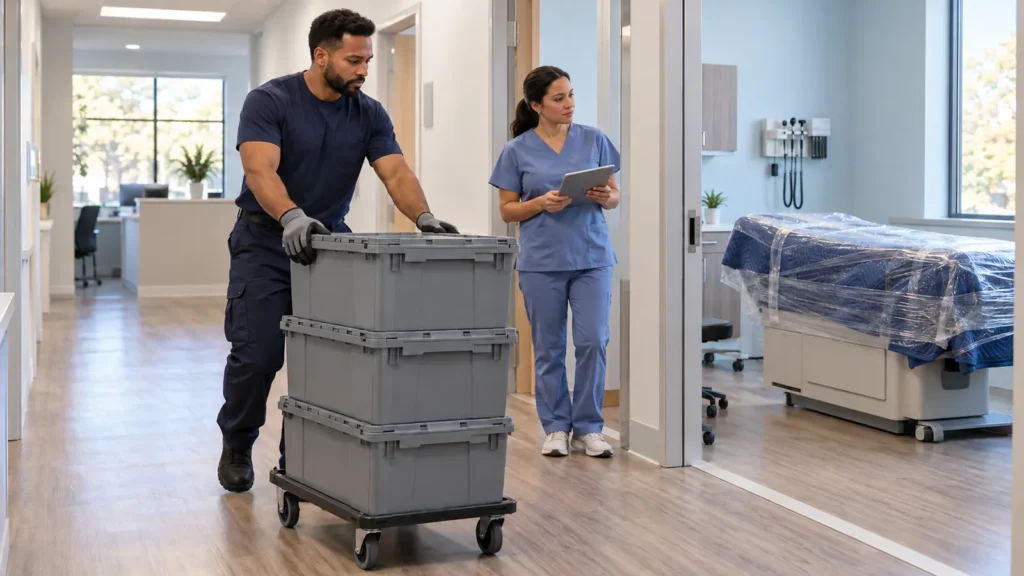
If you manage a medical practice, you already know the move itself is not what keeps you up at night. It is the phone ringing on the first Monday in the new space and the front desk telling a patient that the schedule is down, the sterilizer is not certified yet, and could they come back Thursday. A clinic loses money and goodwill every day it cannot see patients, and most of that loss is decided months before the trucks show up.
We have been moving commercial offices since 1997, and healthcare spaces are some of the least forgiving moves we do. The practices that open on time all do the same handful of things early. Here they are, in roughly the order you will need them.
Start with the paperwork that has nothing to do with furniture
The longest lead items in a medical office move are not physical. Your new address has to land in a surprising number of places, and several of them gate your ability to practice or bill at the new location.
- Payer credentialing. Commercial payers and Medicare need your new service location on file. If claims go out with an address the payer does not recognize, they can deny or hold them. Ask your billing lead how long your largest payers take to process a location change, then work backward.
- Controlled substances. If you keep controlled substances on site, your DEA registration is tied to an address. The registration has to be updated before those substances move, not after. This one is not negotiable, and it is the item practices most often discover late.
- Lab and imaging certifications. In-office labs operating under a CLIA certificate, and imaging equipment registered with the state, each have their own change-of-location rules. Your compliance lead should confirm the timing for each one.
- Everything patient-facing. Your Google Business Profile, your website, appointment reminder templates, referral partners, and the hospital systems that send you patients. A patient who drives to your old suite is a patient who may not reschedule.
None of this is the mover’s job, but a good medical office mover will ask about every item on that list during the first walkthrough, because each one can move your opening date.
Know your building before you sign the move date
Most practices in metro Atlanta sit in medical office buildings on or near hospital campuses: Northside, Emory, Piedmont, Wellstar, and the outpatient towers that have filled in around them. In Nashville, the same is true along the Midtown and West End healthcare corridor. These buildings are busy places with rules that general office towers do not have.
Expect loading docks that are shared with hospital deliveries and sometimes closed to vendors during the day. Expect elevator reservations that only open after clinic hours, infection-control requirements for anything entering a clinical floor, and certificates of insurance with specific additional insureds named by the property manager. Some campuses also require vendor credentialing for anyone working in patient areas. Get the building’s move rules in writing from both the old and new property managers, and send them to your mover before anyone quotes a schedule. A move plan written without them is a guess.
Separate the practice into three kinds of cargo
Everything in a medical office falls into one of three groups, and each one moves differently.
Ordinary office contents. Waiting room furniture, front desk workstations, files that are already digitized, break room equipment. This is standard commercial moving work, and it should be the boring part.
Clinical equipment. Exam tables, dental chairs and delivery units, autoclaves, panoramic and intraoral X-ray, ultrasound, and lab analyzers. Some of it can move with a careful crew. Some of it cannot be touched until the manufacturer’s technician has signed off. Make a simple list that sorts every device into one of those two columns, because the second column sets your move date.
Regulated contents. Paper patient records, controlled substances, vaccines and refrigerated medications, and any device that stores patient data. These are custody problems more than moving problems. They need a documented chain of custody from the moment they leave your control until they are back in it.
When a practice treats all three groups the same way, the clinical and regulated items get rushed, and that is where move-week emergencies come from.
Protect the cold chain
Vaccines and temperature-sensitive medications deserve their own line in the plan. Talk to your pharmacy or vaccine program contact about how they want inventory handled during a relocation. Many practices use qualified transport containers with data loggers, move the inventory last at the old site and first at the new one, and have the new refrigeration units running and stable at temperature before anything goes in them. Keep the logger data. If anyone ever asks whether the cold chain held, you want a record, not a recollection.
Plan the cutover around the front desk
Patients experience your move through the phone and the schedule, not the truck. Start there. Block a lighter schedule for the last two days in the old space and the first two in the new one, so a slow start does not turn into a waiting room full of rescheduled patients. Tell patients about the new address three times: when they book, in the reminder, and the day before, with parking and suite directions that someone on your team has actually walked.
The phones deserve a plan of their own. Port your main number to the new location on a date your carrier has confirmed in writing, keep call forwarding from the old line for several months, and test the after-hours message from an outside line before you leave the old space. Your practice management system and e-prescribing should be live and tested at the new address before the first patient arrives, because a front desk that cannot check anyone in will undo every other part of a good move.
All of that only works when one person owns the full schedule, from the building and the technicians to the network and the punch list. A named project manager who has run this sequence before is worth more to you than any truck.
Let your staff do their jobs during the move
Your clinical staff are not movers, and asking them to pack exam rooms on a patient day is how instruments go missing and charts end up in the wrong box. Have the moving crew handle packing, with a short pre-move session where each provider or lead assistant labels what goes where. Color-coded room labels that match a floor plan of the new suite save hours on the other end.
Give staff a clear plan for the first day in the new space: where supplies are, which rooms are ready, and who to call if something is wrong. Practices that skip this step lose the first morning to people looking for gloves.
What to ask a medical office mover
Before you hire anyone, ask these questions and listen to how specific the answers are.
- Have you moved a practice in this building, or on this campus, before?
- Who will be my project manager, and will that person be on site during the move?
- How do you document chain of custody for records and devices that hold patient data?
- Do your crews work in occupied clinical buildings, and can they meet the campus vendor requirements?
- Will your own in-house crew move my clinical equipment, and have they handled this kind of equipment before?
- Can you store items temporarily if the new suite is not ready on time?
A mover who answers those with names, examples, and documents is a mover who has done this. One who answers with “we move offices all the time” is going to learn on your practice.
How Flood Brothers handles a practice move
We run healthcare relocations in Atlanta and across the Southeast as single projects with one project manager, in-house crews for office contents and clinical equipment, and documented custody for records and data-bearing devices. When a practice needs equipment set up at the new site, our medical equipment installation crews coordinate directly with your vendor technicians. If your new suite is late, our own warehouses can hold everything until it is ready. For larger health systems, our healthcare and laboratory relocation team handles labs, imaging, and multi-site moves.
If you are planning a move in the next year, the best time to call is before you sign the lease, because the building rules and the licensing timeline should shape your move date. Talk to a commercial specialist and we will walk your current space, ask about your equipment and your patients, and give you a written plan you can take to your partners.
Keep Reading

November 10, 2026
Why Q4 Is Commercial Moving’s Busiest Season (and How to Book It)
Lease expirations, budget cycles, and holiday closures all point companies at the same eight weekends. How to win the Q4 booking game.
Read more →
September 22, 2026
Certificates of Insurance for Commercial Moves: What Building Managers Require
The document that stops more move days than weather: what a COI is, what buildings require, and how to get it right the first…
Read more →
September 15, 2026
The Office Relocation Project Plan: Roles, Milestones, and Ownership
Checklists tell you what to do. A project plan tells you who does it and when it must be done. Here is the structure…
Read more →Trusted by industry leaders
Enterprises that count on Flood Brothers
Your team demonstrated a level of urgency and attention to facility protection that I had not seen before.
We highly recommend Flood Brothers without reservation. They were on time, professional, and customer service-oriented.
We are very fortunate to have Flood Brothers as one of our partners, as they are willing to do whatever it takes to provide quality service.
Let's Plan Your Move
Ready to Move Without the Downtime?
Tell us about your project and timeline. We will build a plan around your business and send clear pricing, usually within one business day.