
What Happens to the Furniture When an Atlanta Office Closes
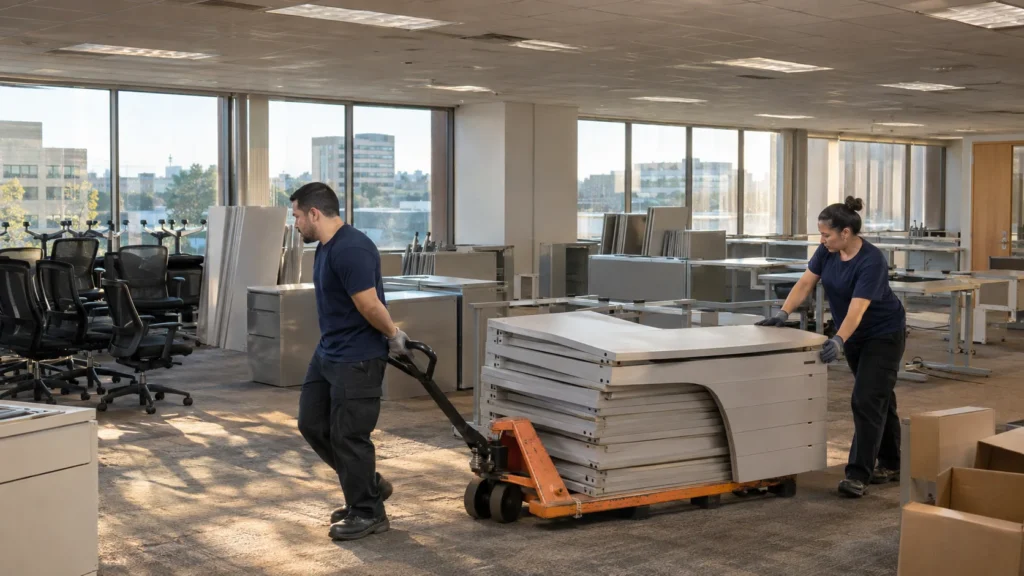
Closing an office is mostly paperwork until about six weeks before the lease ends. Then somebody walks the floor and realizes that every workstation, every chair, every filing cabinet, and that conference table nobody could lift has to be gone, and the space has to be clean, by a date the landlord won’t move. If you’re the facilities manager holding that date, the furniture is your problem now.
Here’s what actually happens to it, and what you can do to keep the process from eating your last month.
Start with an honest inventory
Before you call anyone, count what you have and take pictures. Not a perfect asset list, just the basics: how many workstations and what brand, how many task chairs, how many private offices with case goods, conference tables and their sizes, and storage. Note anything that’s damaged, stained, or missing parts. Photos of a typical workstation, a typical chair, and every unusual piece will get you real answers from buyers faster than any spreadsheet.
While you’re walking, flag what’s not yours. Leased copiers, vending machines, the coffee service, and anything the landlord installed usually stay or go back to their owners, and they shouldn’t end up on a truck by accident.
What used furniture buyers in Atlanta actually want
If you want to sell used office furniture in Atlanta, it helps to think like the buyer. Resellers make money by moving a lot of matching product to the next company that needs it. That means they care about three things: quantity, consistency, and condition.
- Name-brand task chairs in good shape are usually the easiest thing to place.
- Height-adjustable desks have steady demand, especially in matched sets.
- Systems furniture from the major manufacturers sells when it’s a complete, matching run with all the parts. Twenty identical stations are interesting. Seven different ones are not.
- Metal storage like lateral files and storage towers can sell in quantity.
- Conference tables in common sizes sometimes sell. Huge custom tables almost never do.
What buyers pass on: worn or stained seating, chipped laminate, built-ins that can’t come off the wall in one piece, discontinued systems with missing parts, and small mixed lots. That’s not a judgment on your furniture. It’s just that the next buyer has to be able to reuse it without rebuilding it.
Timing matters more than haggling
The single biggest thing you control is how much runway you give the process. A reseller needs time to look at your inventory, line up an end buyer, and schedule a crew. If you call with two months left, there’s room to find a home for the good pieces. If you call with ten days left, you’re mostly paying for removal, because nobody can resell product they can’t schedule around.
So pin down three dates early: when the last employee leaves, when IT pulls the network gear, and when the landlord needs the keys. The furniture work happens between the second and third date, and it needs more days than most people expect.
What doesn’t sell gets sorted, not dumped
Nothing about a closing should end with a dumpster full of desks. Everything that doesn’t sell gets routed into one of three streams.
Donation
Schools, nonprofits, and community groups around metro Atlanta can often use solid furniture that a reseller won’t take, like older desks, chairs in fair condition, and bookcases. Charities have their own rules about what they accept and when they can pick up, so this works best when it’s planned, not used as a last-minute escape hatch. When items go to donation, you should get documentation for your records.
Recycling
Metal storage, steel frames, and many chair components can be recycled. Electronics are their own category. Monitors, computers, phones, and anything with a hard drive should go to a certified e-waste recycler, and drives should be handled according to your company’s data policy before anything leaves the building.
Disposal
What’s left is the true junk: broken pieces, particleboard that won’t survive another move, and odds and ends. On a well-run project this is the smallest pile, not the biggest.
The last step is the one the landlord sees
Read the surrender clause in your lease before you plan anything else. Most Atlanta leases expect the space back broom-clean, and some spell out more, like removing cabling or patching where furniture was anchored. When the last truck leaves, the space should be empty, swept, and ready for the walkthrough. That’s what gets you a clean handback instead of a deduction from your deposit.
Why one crew beats four vendors
You can hire a reseller, a charity pickup, an e-waste company, and a junk hauler separately. Plenty of companies do. The trouble is that four vendors means four schedules, four certificates of insurance for building management, and four chances for someone to show up on the wrong day while the freight elevator is booked for someone else.
When we handle office liquidation in Atlanta, one project manager walks the space, sorts every item into resale, donation, recycling, or disposal, and runs the whole thing on one schedule with our own crews. You get the documentation for donated and recycled items, and you get the space back broom-clean. If you’re also moving part of the team to a new location, our office decommissioning work can run alongside the move so the old space clears the same week.
Quick answers to common questions
Will someone actually pay for our furniture?
Maybe. Matching, name-brand pieces in good condition have a real market. Older or mismatched furniture usually doesn’t, but it can still be donated or recycled instead of landfilled. Send photos and you’ll know quickly.
How early should we start?
As soon as you know the closing date. Two months out gives you real options. Two weeks out mostly gives you a removal bill.
Can we keep a few pieces for another office?
Yes. Tag them during the inventory walk and they’ll be pulled aside, moved to your other location, or held in storage until you need them.
Who handles the building’s move rules?
Your mover should. Dock times, elevator reservations, and the certificate of insurance are part of the job, not something you should be chasing.
If an office closing is on your calendar, talk to a commercial specialist. Send a few photos and your lease end date, and we’ll tell you what’s likely to sell, what will be donated or recycled, and how much time the schedule really needs.
Keep Reading

November 4, 2026
Closing a Nashville Office: Sell, Donate, or Recycle What’s Left
Donating office furniture in Nashville sounds simple until the charity says no to half of it. How to sort what is left into sell,…
Read more →
October 20, 2026
Office Furniture Removal: Disposal, Donation, and Resale Options That Beat the Dumpster
Old office furniture has four exits: resale, donation, recycling, and landfill. How to choose, what each costs, and why the lease deadline decides.
Read more →
April 28, 2026
What Is Commercial Decommissioning, and When Do You Actually Need It?
Commercial decommissioning is how you hand a building back the right way. Here is when you need it, what it covers, and how to…
Read more →Trusted by industry leaders
Enterprises that count on Flood Brothers
Your team demonstrated a level of urgency and attention to facility protection that I had not seen before.
We highly recommend Flood Brothers without reservation. They were on time, professional, and customer service-oriented.
We are very fortunate to have Flood Brothers as one of our partners, as they are willing to do whatever it takes to provide quality service.
Let's Plan Your Move
One Call Starts the Plan
Share your dates and your space. We come back with a written plan, usually within one business day.