
Delivering Into Nashville’s New Towers Without Scratching a Thing
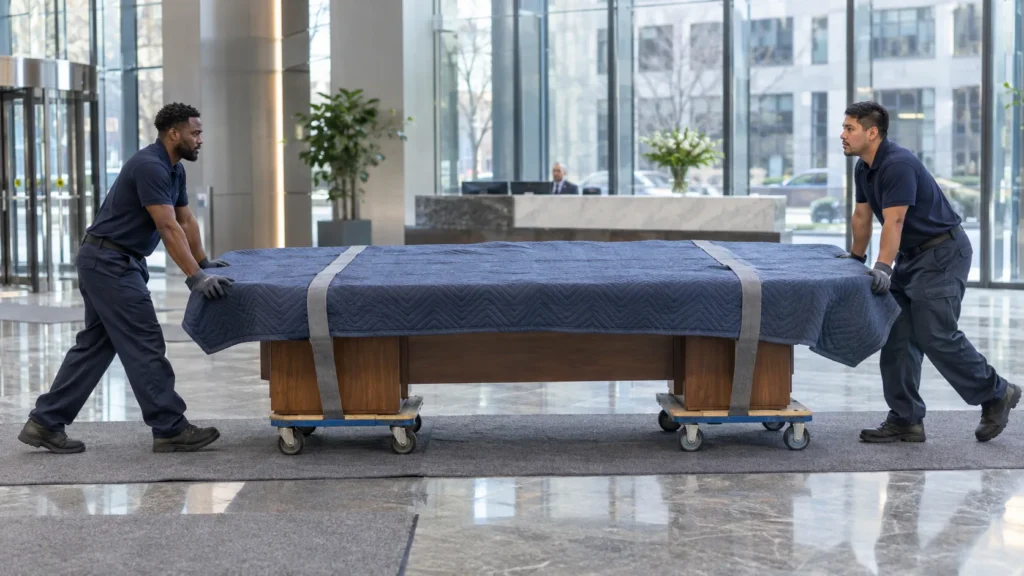
A new building is the hardest place to deliver to without leaving a mark. Everything is fresh: the lobby stone, the elevator panels, the corridor paint that went on last month. The property manager knows it, the building engineer knows it, and if a cart clips a door frame on the way to your suite, you’re the tenant who gets the call.
Nashville has added a lot of new office space in the last several years, in the Gulch, SoBro, Midtown, and along the riverfront, and many of those buildings are still filling up. That means more deliveries, more tenant build-outs, and buildings that are protective of their finishes. Here’s how to plan a Nashville high-rise delivery so it goes in clean.
Why new buildings are different
Older buildings have been dinged before. Newer ones haven’t, and their managers would like to keep it that way. You’ll often see stricter protection rules, more specific delivery windows, and closer supervision on the first few deliveries. In a building that’s still leasing up, you may also be sharing the dock and freight elevator with contractors finishing other floors. That’s not a problem if you plan for it. It’s a big problem if you don’t.
Get the building’s rules before you set a date
Ask the property manager for the current vendor or move packet. It should cover:
- Allowed delivery times and how to reserve them
- Loading dock access, truck size limits, and how long a truck can stay
- Freight elevator reservations, cab size, and weight limits
- Certificate of insurance requirements, including additional insured names and the certificate holder
- Required floor, wall, and elevator protection
- Who to contact on delivery day
Send that packet to your delivery company before they give you a schedule. If they don’t ask for it, that tells you something.
Protection is the whole game
Most damage during a delivery happens in the path, not in the room. Scuffed floors in the lobby, a gouge in the elevator cab, a dented corner where a long piece turned too tight. You prevent that with protection that goes down before the first item comes off the truck.
Floors
Finished floors in the lobby and corridors should be covered with runners or board along the whole path. Polished concrete and stone are easy to scratch with grit from a dolly wheel.
Walls and corners
Corner guards on tight turns and door frames, especially where long items have to pivot. New paint marks easily and is a pain to touch up to match.
Elevators
The freight cab should be padded. If the building lets you use a passenger car for a small delivery, it needs protection too, and you’ll want the building’s okay first.
The furniture itself
Blanket wrap on every piece that isn’t in its original packaging, and careful handling of anything with glass, stone, or a finished veneer. Unwrapping happens in the room, not in the hallway.
Timing in a busy building
If contractors are still working on other floors, ask the building which days are lightest on the dock and elevator. Early mornings and weekends are common choices. Build in a buffer: if the elevator is tied up when you arrive, you don’t want the truck running into its time limit at the dock.
It also helps to sequence the load. The items going to the farthest room come off first, or last, depending on the layout, so nothing gets set down in a corridor and left there while the crew figures out where it goes.
Placement and cleanup
Getting it upstairs is half the job. The other half is putting it where it belongs. Have a floor plan with each item marked, and make sure the crew has a copy. Once everything is placed, the packaging should leave with the crew. A new building’s trash room is not the place for a pile of cardboard and foam.
Before the crew leaves, walk the path with them. Look at the floor, the corners, and the elevator. If everything looks the way it did when you started, that’s a good delivery.
How we handle it
For white glove delivery in Nashville, our Tennessee crews coordinate with the building, provide the certificate of insurance, and handle the dock and elevator timing. Every piece gets blanket wrap, floors and the path get protected, items are placed inside the space according to your floor plan, and the packaging goes with us. We document condition with a photo report. If your suite isn’t ready yet, we can receive the shipment at our warehouse and hold it until the building and the space are ready. Our white glove delivery page covers the full service.
Common questions
Can you deliver while contractors are still on site?
Usually, yes. We’ll coordinate dock and elevator time with the building so we’re not in each other’s way.
What if something is damaged in shipping before it reaches us?
That’s what the photo condition report is for. It shows what arrived and how it looked, which helps you sort it out with the vendor.
Do you take the packaging?
Yes. Cardboard, foam, and crates leave with the crew.
Can you deliver after hours?
If the building allows it, yes. Many newer towers prefer it for larger deliveries.
If you’ve got a delivery headed into a Nashville tower, talk to a commercial specialist. Send the building’s vendor packet and your item list, and we’ll plan a delivery that leaves the finishes exactly how you found them.
Keep Reading

November 4, 2026
Moving a CNC Machine Out of an Atlanta Plant, Step by Step
A CNC machine is heavy, top-heavy, and built to hold tolerances. How one gets out of an Atlanta plant and running again somewhere else,…
Read more →
November 4, 2026
Getting Deliveries Into Atlanta High-Rises: Docks, Elevators and COIs
A delivery into an Atlanta tower can fail before the truck leaves the warehouse. The dock, elevator, and COI rules that decide whether your…
Read more →
November 3, 2026
What Machinery Movers Actually Do: Rigging, Permits, and Heavy Equipment
A 12,000-pound CNC machine does not go on a dolly. What rigging crews actually do, and when your project needs one.
Read more →Trusted by industry leaders
Enterprises that count on Flood Brothers
Your team demonstrated a level of urgency and attention to facility protection that I had not seen before.
We highly recommend Flood Brothers without reservation. They were on time, professional, and customer service-oriented.
We are very fortunate to have Flood Brothers as one of our partners, as they are willing to do whatever it takes to provide quality service.
Let's Plan Your Move
Let's Put a Real Plan on Paper
Walk us through what is moving and when. You get a written project plan back, usually within one business day.