
Moving a CNC Machine Out of an Atlanta Plant, Step by Step
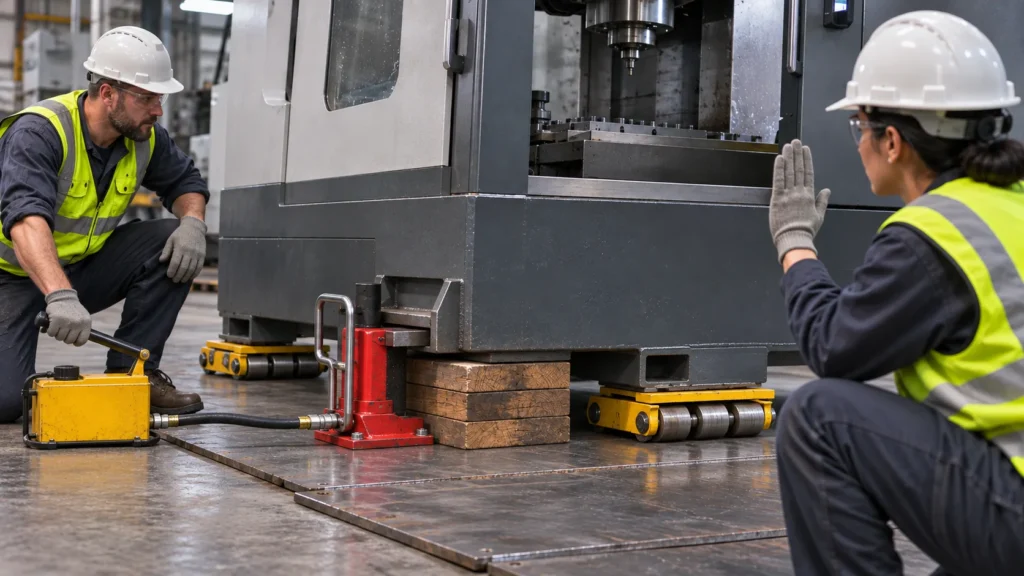
A CNC machine is one of the most valuable things on a plant floor, and one of the easiest to damage in a move. It’s heavy, often top-heavy, and built around precise alignment. Drop it an inch, twist it while it’s on skates, or set it on a floor that can’t carry it, and you’re not just looking at repairs. You’re looking at weeks of lost production while the machine gets sorted out.
If you’re a plant manager or maintenance lead getting ready to move one, here’s how it works, step by step.
Step 1: Gather the machine’s information
Start with the manufacturer’s manual and any rigging or installation documents that came with the machine. You’re looking for the weight, the center of gravity, the designated lifting points, and any shipping brackets or locks that hold moving parts in place during transport. If the original documents are gone, the manufacturer can usually provide them.
Write down the machine’s model and serial number, and photograph it from every side, including the control panel and any connections. Those photos are useful when it’s time to hook everything back up.
Step 2: Plan the path out
Walk the whole route from the machine’s current spot to the truck. Check door widths and heights, overhead obstructions like pipes and conduit, floor transitions, ramps, and the dock. Note anything that’s in the way and has to move first, like racking or other equipment.
This is also when the riggers do a load survey: looking at the floor the machine will travel over, the dock, and the floor at the new site, so the weight on each spot stays within what it can safely carry. If a section of floor is questionable, the plan changes before moving day, not during it.
Step 3: Shut down and disconnect
Your maintenance team or the machine’s service tech usually handles this part, because they know the machine. Typical steps:
- Back up programs, offsets, and parameters from the control.
- Have a qualified electrician disconnect power.
- Disconnect air, coolant lines, and any network or data cables.
- Drain coolant and lubrication systems as the manufacturer recommends.
- Remove chips and clean out the machine.
- Install shipping brackets or locks on axes, spindle heads, and tool changers, per the manual.
- Remove or secure accessories like chip conveyors, tool magazines, and enclosures if they ship separately.
Label everything you disconnect. It saves hours on the other end.
Step 4: Rig the machine
Now the riggers take over. Depending on the machine and the building, they’ll use jacks to lift it off the floor, skates to roll it, forklifts sized for the load, or a gantry where overhead lifting makes more sense. When the machine has to clear something big, or get in or out through an opening that’s not at ground level, a crane assist may be part of the plan.
Throughout this step, the riggers lift only at the designated points, keep the machine level, and move slowly. A CNC machine shouldn’t be tipped or racked, because its alignment depends on the base staying true.
Step 5: Load and transport
The machine is loaded onto an air-ride trailer, which cuts down the vibration and shock that a standard suspension would pass up into the machine. It’s secured to the trailer at points that won’t stress the frame or the castings, and it’s covered to protect it from weather and road debris.
Plan the route ahead of time, too. Heavy or oversized loads may need specific routes or permits, and the timing has to match when the new site’s dock and floor are ready.
Step 6: Set and re-level at the new site
At the new location, the process runs in reverse. The machine comes off the trailer, travels to its new spot, and gets set on its foundation or pads. Then it’s leveled back to the manufacturer’s tolerance. Getting the level right is what lets the machine hold its accuracy, so this step shouldn’t be rushed.
Step 7: Reconnect and verify
Your electrician reconnects power, and your team or the service tech reconnects air, coolant, and data. Remove the shipping brackets, restore programs and parameters, and let the manufacturer’s tech or your own maintenance team run the checks they need before production starts.
Who does what
A CNC move works best when each person sticks to what they know. Your team or the service tech handles the machine’s systems. Electricians handle power. The riggers handle the lift, the move, transport, and setting it level. When everybody knows their part, the machine gets back to making parts faster.
For industrial rigging in Atlanta, our in-house riggers handle the load survey, the jacks, skates, gantries, forklifts, and crane assists, air-ride transport, and re-leveling to tolerance at the new site. We also offer 24/7 emergency support for when something can’t wait. For more about how we handle heavy equipment across the Southeast, see our industrial rigging page.
Common questions
Can you move the machine without disconnecting it ourselves?
Disconnecting power should be done by a qualified electrician, and the machine systems are best handled by your team or the manufacturer’s tech. We coordinate the schedule around them.
Do you calibrate the machine after the move?
We re-level it to the manufacturer’s tolerance. Any calibration or accuracy checks after that should be done by your team or the manufacturer’s service tech.
What if the floor at the new site can’t handle the weight?
That’s what the load survey is for. It catches floor issues before moving day so the plan can account for them.
How long does it take?
It depends on the machine, the path, and the distance. A site walk is the fastest way to a real answer.
If you’ve got a CNC machine to move, talk to a commercial specialist. Send the machine’s model and some photos of the path, and we’ll plan the move from disconnect to re-level.
Keep Reading

November 4, 2026
Delivering Into Nashville’s New Towers Without Scratching a Thing
Brand-new buildings are the easiest to damage. What to plan before a delivery into one of Nashville's newer towers so the finishes look the…
Read more →
November 4, 2026
Getting Deliveries Into Atlanta High-Rises: Docks, Elevators and COIs
A delivery into an Atlanta tower can fail before the truck leaves the warehouse. The dock, elevator, and COI rules that decide whether your…
Read more →
November 3, 2026
What Machinery Movers Actually Do: Rigging, Permits, and Heavy Equipment
A 12,000-pound CNC machine does not go on a dolly. What rigging crews actually do, and when your project needs one.
Read more →Trusted by industry leaders
Enterprises that count on Flood Brothers
Your team demonstrated a level of urgency and attention to facility protection that I had not seen before.
We highly recommend Flood Brothers without reservation. They were on time, professional, and customer service-oriented.
We are very fortunate to have Flood Brothers as one of our partners, as they are willing to do whatever it takes to provide quality service.
Let's Plan Your Move
One Call Starts the Plan
Share your dates and your space. We come back with a written plan, usually within one business day.